Ecuador, Paraguay, and Uruguay Are in the World Cup. Here's Where Montreal Eats.
Three South American sides at WC 2026, three very different Montreal stories. One has a dedicated room, one has the pan-Latin corridor, one has the home kitchen. Honest map for match nights.
Published
The Southern Cone trio that locked their tickets to the 2026 World Cup are not the ones most casual fans will name first. Argentina and Brazil suck up the air in any CONMEBOL conversation. But Ecuador finished second in the South American qualifiers, Uruguay landed in the top group on points, and Paraguay clawed back into the tournament after missing 2018 and 2022. Three teams. Three quietly serious sides. The group draw lands December 5, 2025 in Washington, D.C., and the tournament runs June 11 to July 19, 2026 across Canada, the United States, and Mexico.
The Montreal angle is more complicated than the football. None of these three diasporas have a deep restaurant footprint here. Ecuador has the most visibility on the plate, Paraguay almost none, Uruguay somewhere in between with one signature dish that floats across pan-Latin menus. The honest framing is that Montreal's Latin American food story runs through a handful of dedicated rooms and the Saint-Laurent corridor that locals call Little Latin America. The Saint-Denis side of the Plateau is mostly Québécois and French. The Latin community concentrates further north, between Jean-Talon and Beaubien on Saint-Laurent, with cevicherías and groceries-and-counters scattered across Côte-des-Neiges and the southwest.
Ecuador. La Tri finished second in CONMEBOL qualifying with the fewest goals conceded in the entire group, behind only Argentina on points. Moisés Caicedo runs the midfield. Sebastián Beccacece coaches a side that does not give up much and waits to punish. A round of 16 is the floor. A quarter-final is on the table if the bracket cooperates. Watch the centre-backs Piero Hincapié and Willian Pacho. The spine is the story.
In Montreal, the Ecuadorian community is small but visible enough to support a dedicated room. La Hueca by Masa at Le Faubourg Sainte-Catherine downtown is the address. Street-food framing, with encebollado (tuna and yuca in a tomato-onion broth that locals treat as hangover insurance), ceviches, salchipapa, and grilled meats. The Faubourg setting is a downtown mall counter, not a destination room, but the cooking is the genuine article and the portions are generous. For hornado (slow-roasted pork shoulder) the answer in Montreal is still a home kitchen, not a menu.
Paraguay. La Albirroja are back at a World Cup for the first time since 2010, after missing 2014, 2018, and 2022. Argentine coach Gustavo Alfaro took the job in 2024 and rebuilt the team's discipline and identity in less than two years. The qualifying campaign was the patient kind. Tight blocks, set pieces, and just enough up top. The squad is defensive and tactical with Antonio Sanabria leading the line and Miguel Almirón the most familiar name to a North American audience. Group stage is the test. Anything beyond that is upside.
Paraguay has almost no dedicated culinary presence in Montreal. Sopa paraguaya, despite the name, is a dense cheese cornbread, not a soup. Chipa is the cheese-bread cousin that travels well. Both are home-cooking food, not menu food, and you will not find them on a Montreal restaurant menu in 2026. The fallback is the pan-Latin counter at Sabor Latino on Saint-Laurent, where the grocery side is the actual play. Pick up queso fresco, masa, and yerba mate, and cook the cornbread yourself for the match. The Paraguayan diaspora here mostly does the same.
Uruguay. La Celeste are in a generational handover. Edinson Cavani retired from the national team. Luis Suárez has stepped back. José Giménez wears the armband, Federico Valverde runs the midfield, and Darwin Núñez, Manuel Ugarte, and Ronald Araújo fill in the new core. Marcelo Bielsa coaches. The 5-1 loss to the United States in November 2025 wobbled the project but Bielsa kept his post and the squad is built for a deep run. A quarter-final is the realistic ceiling. The semis are not crazy.
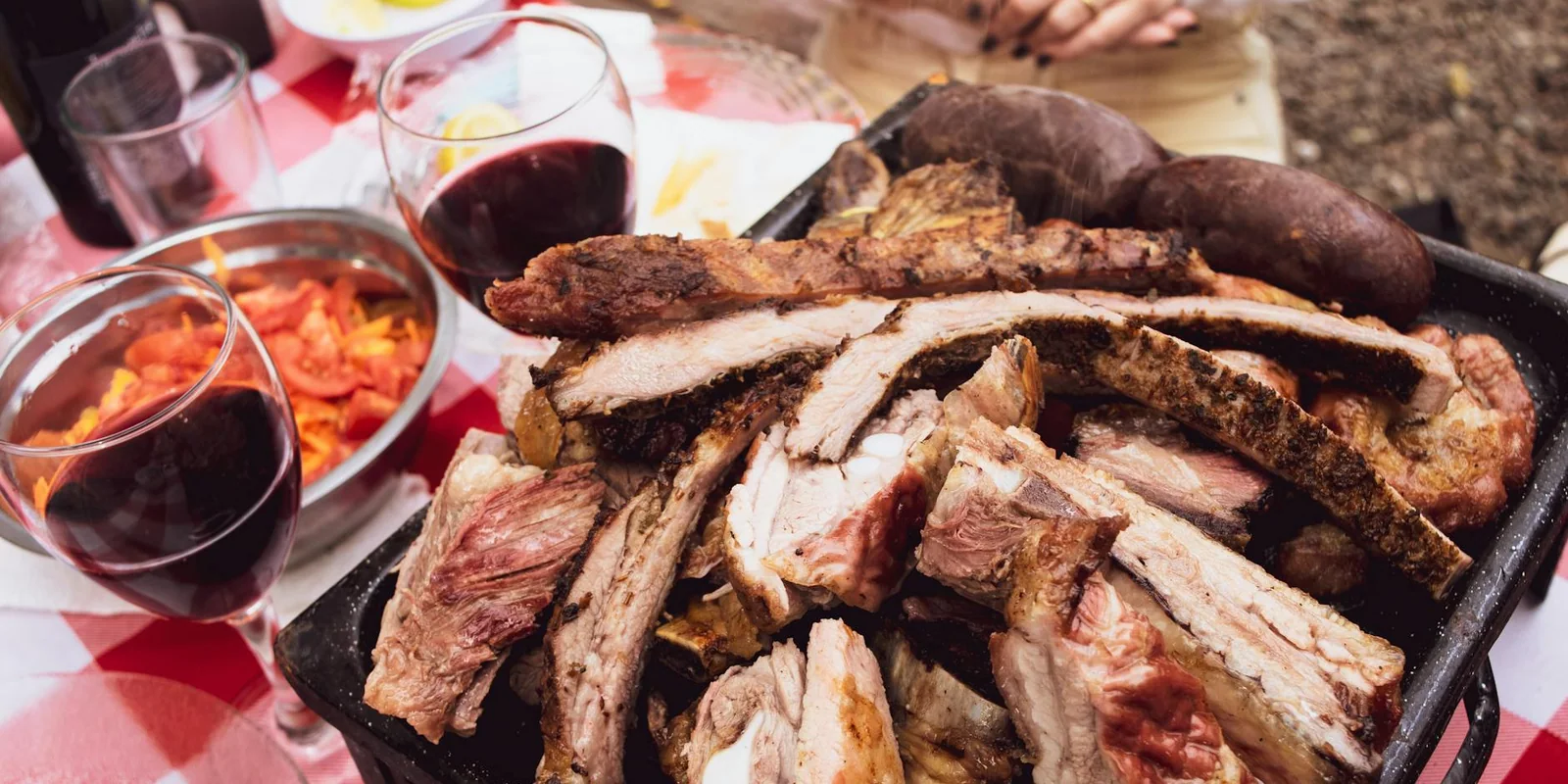
Uruguay has no dedicated restaurant in Montreal. The chivito sandwich (churrasco, ham, mozzarella, egg, lettuce, tomato, olives, mayo on a soft bun) is the calling card and it shows up as a guest item on a handful of pan-Latin and Argentinian-aligned menus, never as a sit-down room of its own. Asado with the Uruguayan touch lands closest at the Argentinian grills in Verdun and Côte-des-Neiges. The mate culture, though, is alive. Walk through Parc Lafontaine or Parc Jarry on a summer Sunday and you will see the gourd and the thermos in Latin family groups. That is the closest you get to a Uruguayan Sunday in Montreal.
None of these three trios make for a clean restaurant list. That is the honest part. La Hueca is the only address with a dedicated kitchen across all three flags. Sabor Latino is the grocery-counter hybrid that fills the gap for the dishes that do not yet have a menu home in Montreal. The Argentinian rooms (Beba, Sabrosa, the Avenue Victoria empanada counters) cover the asado and parrilla angles for Paraguay and Uruguay match nights. For the rest, the Montreal answer is a home kitchen, a friend's invitation, and a screen tuned to whichever broadcaster has the rights. Bring a mate if you have one.
Frequently asked questions
Where do South Americans gather in Montreal during the World Cup?
The biggest crowds land in Old Port restaurants, Plateau cocktail bars, and the Saint-Laurent corridor between Jean-Talon and Beaubien, sometimes called Little Latin America. Argentinian and Brazilian match days draw the largest rooms. Ecuador, Paraguay, and Uruguay games tend to gather in smaller pan-Latin spots and at home.
What's the difference between Argentinian, Uruguayan, and Paraguayan asado?
All three are wood-fired beef. Argentinian asado leans long and slow with chimichurri and a wider cut selection. Uruguayan asado is closer in technique but features the chivito sandwich as its sit-down headline. Paraguayan asado often comes with sopa paraguaya, a dense cheese cornbread, and chipa on the side. The seasoning is light across the board. Salt, smoke, and time do the work.
Where do you find chivito sandwiches in Montreal?
There is no dedicated Uruguayan room in Montreal as of 2026. The chivito shows up as a guest item on a handful of pan-Latin and Argentinian-aligned menus, usually built with churrasco, ham, cheese, egg, lettuce, tomato, and olives on a soft bun. The cleanest path is to call ahead, ask if it is running, and accept that the home kitchen of an Uruguayan friend is the real answer.
Will Uruguay or Ecuador make the knockouts?
Both finished CONMEBOL qualifying in strong shape and both should clear the group stage in a 48-team format. Ecuador conceded the fewest goals in the qualifiers and rides on a defensive spine. Uruguay carries a generation built around captain José Giménez and engine-room midfielder Federico Valverde under Marcelo Bielsa, with a real shot at the quarter-final. Paraguay is back at a World Cup for the first time since 2010, after missing 2014, 2018, and 2022, and will count survival of the group as the win.